

Returns and Refunds Pakistan: Complete Guide for Online Sellers
Returns and refunds Pakistan policy isn’t optional paperwork — it’s a legal requirement most online sellers overlook. Under Section 20 of the Punjab Consumer Protection Act 2005, you must disclose your return and refund policy to buyers clearly before they complete a purchase. Skip this, and you’re not just risking a bad customer experience. You’re exposing your business to fines and formal complaints.
This guide covers what the law actually requires, how to write a policy that protects both you and your customers, and how to handle disputes when they come up.
What Pakistani Law Actually Requires
Several provincial consumer protection laws govern returns and refunds Pakistan sellers must follow. The Punjab Consumer Protection Act 2005 requires you to disclose your return and refund policy clearly, using a sign at the point of purchase — for online sellers, this means displaying it visibly on your product or checkout page, not burying it in a footer link. Violations can bring fines up to PKR 50,000, and complaints go before the Consumer Protection Council or a Consumer Court headed by a District Judge.
The Khyber Pakhtunkhwa Consumer Protection Act 1997 works similarly, giving consumers the right to a refund, replacement, or compensation if a product turns out defective, substandard, counterfeit, expired, or different from what you advertised. As a result, if your listing shows one thing and the customer receives another, they have real legal grounds to demand their money back — regardless of what your own store policy says.
Why a Clear Return Policy Protects You Too
A well-written policy isn’t just a legal box to check. It actively reduces disputes, because customers know exactly what to expect before they buy. Research on Pakistani e-commerce has found that many online sellers either have no visible return policy at all, or apply vague, inconsistently enforced rules — and this ambiguity is exactly what leads to disputes escalating into formal complaints or chargebacks.
In addition, because Pakistan’s E-Commerce framework recognizes electronic records as valid evidence, your own order confirmations, chat messages, and product listings can work in your favor during a dispute — but only if you’ve kept your policy consistent and your communications documented from the start.
What to Include in Your Returns and Refunds Policy in Pakistan
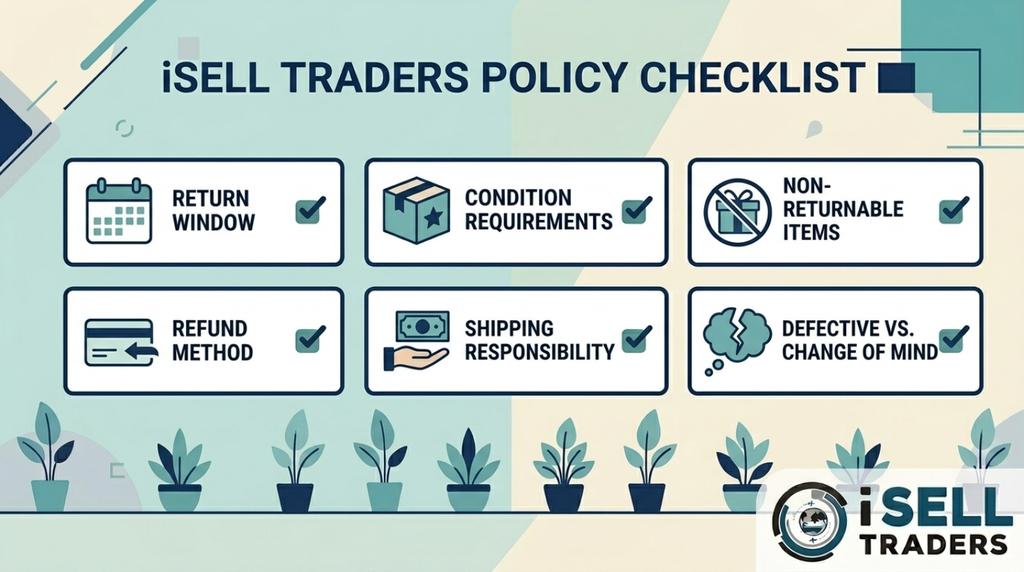
- Return window: how many days after delivery a customer can request a return (commonly 7–14 days for e-commerce in Pakistan).
- Condition requirements: whether the item must be unused, in original packaging, with tags attached.
- Non-returnable categories: clearly list exclusions, such as perishables, personalized items, or intimate goods.
- Refund method and timeline: whether you refund to the original payment method, offer store credit, or process bank transfers, and how many days this takes.
- Who pays return shipping: this varies by seller, but state it explicitly rather than leaving it as a point of dispute later.
- Defective vs. change-of-mind returns: these often carry different rules, so separate them clearly in your policy.
How to Handle a Return or Refund Request in Pakistan
- Respond quickly. A slow response is one of the fastest ways to escalate a simple request into a formal complaint.
- Verify the claim. Ask for photos or a short video if the customer reports damage or a defect, before approving the return.
- Apply your stated policy consistently. Inconsistent handling between customers is exactly what draws legal scrutiny under consumer protection law.
- Document everything. Keep order confirmations, chat logs, and photos on file — these become your evidence if a dispute escalates.
- Process the refund within your stated timeline. Delayed refunds, even when the return itself was approved, are a common source of continued complaints.
Common Problems in returns, refunds, How to Handle Them
Problem: A customer claims the product arrived different from the listing.
Way out: compare the return against your original product photos and description. Because your listing itself is evidence, make sure it’s accurate from the start — this single habit prevents most disputes of this kind before they even happen.
Problem: You suspect a customer is abusing your return policy.
Way out: your policy’s stated conditions — like requiring original packaging or a limited return window — exist specifically to manage this. Apply them consistently, and don’t make informal exceptions that undermine your own stated rules.
Problem: A customer escalates a complaint to the Consumer Protection Council.
Way out: this isn’t necessarily as serious as it sounds if your policy was clearly disclosed and you followed it. Bring your documented evidence — order records, your published policy, and communication history — since the process weighs whether you met your disclosure and service obligations.
Problem: You’re not sure whether your current policy is legally compliant.
Way out: at minimum, make sure your policy is visible on your product or checkout pages (not just buried in a separate page), and that it doesn’t contradict a customer’s basic legal right to a refund for defective or misrepresented goods. When in doubt, a short consultation with a local lawyer familiar with consumer protection law is a small cost compared to a formal complaint.
Final Thoughts about returns and refunds Pakistan
Returns and refunds Pakistan law exists to protect both sides of a transaction, not just the customer. A clear, visible, consistently applied policy reduces disputes, builds trust with buyers, and keeps you on the right side of provincial consumer protection requirements. Write it once, display it prominently, and follow it the same way every time — that’s genuinely most of what the law asks for.
Suggested internal links (add where relevant):
- Start an E-commerce Business in Pakistan
- JazzCash and Easypaisa Payment Gateway Pakistan
- Daraz/Shopify seller accounts
Suggested external links (authoritative sources):
- Punjab Consumer Protection Act 2005 (official text)
- Directorate of Consumer Protection Council, Punjab
- FIA Cyber Crime Wing
Tags: returns and refunds Pakistan, e-commerce return policy Pakistan, consumer protection act Pakistan, refund rights online shopping, Punjab Consumer Protection Act, online seller policy Pakistan, dispute resolution e-commerce, return policy checklist, buyer protection Pakistan, e-commerce law Pakistan