
How to find international buyers for export is one of the most important skills for anyone who wants to build a successful export business from Pakistan. Whether you sell textiles, leather products, sports goods, surgical instruments, rice, salt, garments, or other Pakistani products, finding reliable international buyers is the first major step toward receiving export orders and building long-term business relationships.
Fortunately, Pakistani exporters can now reach customers around the world without having an office in every country. B2B marketplaces, Google, LinkedIn, trade directories, customs and trade-data platforms, business associations, international exhibitions, social media, and direct email outreach can all be used to find potential importers and distributors. In this guide, we explain how to find international buyers for export step by step, from choosing a target market and identifying genuine buyers to sending quotations, negotiating orders, and arranging international shipping.
How to Find International Buyers for Export: The Basic Formula
Think about international selling as a simple seven-step process:
Product → Target Market → Buyer → Contact → Quotation → Order → Shipment
First, you choose a product that Pakistan can supply competitively.
Next, you identify countries where that product is already being imported.
Then, you find companies in those countries that purchase the product.
After that, you contact those companies professionally.
If the buyer is interested, you send a quotation and negotiate the commercial terms.
Once both parties agree, you receive the order and payment according to the agreed terms.
Finally, you prepare the goods and export them from Pakistan.
Therefore, finding a buyer is not the end of the export process. It is the beginning of a complete international business relationship.
Step 1: Choose the Product You Want to Export
Before searching for customers, you must know exactly what you are selling.
Do not simply say:
“I export Pakistani products.”
That is too broad. Instead, describe your product clearly.
For example:
- Pakistani Basmati rice
- Himalayan pink salt
- Sialkot footballs
- Leather jackets
- Sports gloves
- Surgical instruments
- Cotton towels
- Bed sheets
- Denim garments
- Home textiles
- Handmade leather products
The more specific your product is, the easier it becomes to find the right buyer.
For example, instead of targeting:
textile buyers
you could target:
organic cotton towel importers in Germany or:
hotel linen wholesalers in the United Kingdom
This is called product + market targeting, and it can dramatically improve your chances of finding serious buyers.
Step 2: Research Which Countries Buy Your Product
Do not choose a country simply because you like it.
Instead, find out where your product already has demand.
For example, if you sell textiles, you might investigate markets in:
- United States
- United Kingdom
- Germany
- France
- Italy
- Netherlands
- UAE
- Saudi Arabia
- Canada
- Australia
If you sell sports goods, investigate countries with strong sportswear, football, fitness, or sporting-goods markets.
If you sell surgical instruments, research countries where medical distributors and healthcare suppliers regularly import such products.
The goal is simple:
Find countries where businesses already buy the type of product you can supply.
Step 3: Learn Your HS Code
One of the most important things an exporter should learn is the product’s HS Code.
HS stands for Harmonized System.
The HS Code is used internationally to classify products for customs and trade purposes.
For example, instead of searching only for:
Pakistan leather products
you can combine your research with the relevant HS classification and investigate import markets, competitors, tariffs, and trade flows.
However, never guess an HS Code merely because it appears on an internet website. Confirm the appropriate classification with the relevant customs or trade professional before using it for an actual shipment.
Step 4: Use Pakistan Export Data and Trade Intelligence
One of the smartest ways to find buyers is to study actual international trade activity.
Instead of asking:
“Who might buy my product?”
you can investigate:
“Which companies are already importing this product?”
Trade-intelligence databases can provide information about international shipments, suppliers, buyers, products, ports, and trade routes, although the amount of information and pricing varies by provider.
For example, commercial platforms such as trade-data services can be used to investigate buyer and shipment activity. Some platforms market tools specifically for buyer identification, supplier discovery, HS-code research, and shipment intelligence. (Pak Trade Data)
The World Bank also maintains an Exporter Dynamics Database based on customs transaction datasets, although it is primarily a research resource rather than a ready-made buyer-contact database. (World Bank)
What Should You Search For?
Suppose you export towels. You could investigate:
cotton towel importers USA
hotel towel buyers UAE
textile importers Germany
towel distributors UK
HS code towel imports United States
This gives you a much more targeted list of potential customers.
Step 5: Join Global B2B Marketplaces
One of the easiest ways for a new exporter to reach international buyers is through B2B marketplaces.
These platforms allow businesses to create supplier profiles, upload products, respond to buyer inquiries, and sometimes submit quotations to purchasing requests.
There are many platforms available, so you should not depend on only one.
1. Alibaba.com
Alibaba.com is one of the largest global B2B marketplaces.
It allows businesses to create supplier profiles, display products, communicate with buyers, and respond to sourcing requirements.
Alibaba currently states that millions of buyers source through its marketplace and also offers supplier verification and transaction-protection features. (Alibaba)
How to use Alibaba as a Pakistani Exporter
- Create a business account.
- Complete your company profile.
- Select your correct product categories.
- Upload professional product photographs.
- Write detailed product descriptions.
- Mention MOQ.
- Mention available packaging.
- Mention production capacity.
- Add certifications where applicable.
- Respond quickly to buyer inquiries.
Do not copy another supplier’s profile.
Build your own identity around your actual manufacturing or sourcing capabilities.
2. Trade Wheel
TradeWheel Pakistan Marketplace is another B2B marketplace with a Pakistan-focused supplier and buyer presence.
Its Pakistan marketplace is designed to connect Pakistani suppliers with international buyers and lists products across categories such as sportswear, rock salt, textiles, food products, and other goods. (TradeWheel)
How to Use TradeWheel
Create your company profile and then:
- Add your products.
- Upload photographs.
- Mention your MOQ.
- State your production capacity.
- Add your location.
- Provide business contact information.
- Respond to buyer inquiries.
- Monitor buying leads.
3. Global Sources
Global Sources is another established B2B sourcing platform, particularly useful for businesses involved in international sourcing and manufacturing.
It can be useful when targeting professional buyers, sourcing companies, and importers.
However, always compare the platform’s current seller packages, fees, verification requirements, and buyer access before paying for a subscription.
4. Made-in-China
Made-in-China.com is strongly associated with Chinese manufacturing, so it may not be the first platform a Pakistani exporter considers.
Nevertheless, global B2B marketplaces are not all identical. Some are better suited to particular industries and buyer groups.
Therefore, research the platform’s current policies and whether Pakistani suppliers are accepted in your product category before investing time or money.
5. EC21
EC21 is a global B2B marketplace connecting buyers and suppliers internationally. Its platform includes supplier directories, buying leads, product categories, and business communication features. EC21 says it serves importers and exporters in more than 200 countries. (EC21)
This can be another channel for Pakistani exporters looking to diversify their buyer-generation strategy.
6. ExportersWorlds
ExportersWorlds is another marketplace specifically focused on connecting exporters, manufacturers, suppliers, and international buyers.
Its website currently presents categories including agriculture, apparel, beauty, machinery, chemicals, electronics, textiles, food, and home furnishings. (Exporters Worlds)
Before relying on any newer B2B platform, however, check its buyer activity, verification process, traffic, pricing, and reputation.
7. Business4World and Similar B2B Directories
You may also come across platforms such as Business4World and other global B2B directories.
The important rule is:
Do not join a platform simply because it says “millions of buyers.”
Before paying for a premium account, check:
- Is the website active?
- Are recent buyer inquiries visible?
- Are Pakistani exporters allowed?
- Can you see the buyer’s company information?
- Are buyers verified?
- Are there independent reviews?
- What exactly does the paid package provide?
- Can you cancel the subscription?
- Are there additional lead-generation charges?
A free account can often be used first to test whether a platform actually generates useful inquiries.
Step 6: B2B Portals to Find International Buyers for Export
You do not have to search Google manually for every B2B marketplace.
Directories such as B2BSources maintain lists of B2B marketplaces and allow users to explore platforms by region and industry. Its current directory covers dozens of marketplaces across multiple countries and industries. (B2B Sources)
This is useful because different products perform better on different platforms.
For example:
Textiles → textile-specific platforms
Machinery → industrial B2B platforms
Food → food-trade directories
Fashion → apparel and wholesale platforms
Therefore, do not simply join ten random websites. Join the platforms where your buyers are most likely to be.
Step 7: Use Industry-Specific Directories
General B2B marketplaces are useful, but specialized directories can sometimes produce better leads.
For example, if you manufacture textiles, search for:
textile manufacturers in Pakistan
Pakistan textile exporters
organic cotton suppliers Pakistan
home textile suppliers Pakistan
If you sell surgical products, target:
surgical instruments manufacturers Pakistan
surgical instrument exporters Pakistan
medical equipment distributors USA
If you sell leather:
leather products wholesale suppliers Pakistan
Pakistani leather manufacturers
leather goods importers Europe
This is where your product-specific SEO strategy becomes extremely powerful.
Step 8: How to Find International Buyers for Export Using Google
Google is one of the most powerful free tools available to an exporter.
Suppose you sell leather jackets.
Do not search only:
leather jacket buyers
Instead, search combinations such as:
- leather jacket importer USA
- leather jacket wholesaler UK
- leather fashion distributor Germany
- leather products importer UAE
- leather goods wholesale buyer Canada
Then visit company websites.
Look for:
- Purchasing Manager
- Procurement Manager
- Import Manager
- Sourcing Manager
- Buyer
- Wholesale Department
- Business Development Manager
You are looking for the person who can actually purchase your product.
Step 9: Use LinkedIn to Find Purchasing Managers
LinkedIn can be extremely useful for B2B prospecting.
For example, search:
Procurement Manager textile USA
or:
Import Manager sportswear UK
or:
Sourcing Manager leather Germany
Then:
- Open the person’s profile.
- Check their company.
- Visit the company website.
- Verify that the company actually imports your product.
- Send a professional connection request.
- Start a business conversation.
Do not immediately send a huge advertisement.
First establish relevance.
Step 10: Use Facebook Groups and Business Communities
Facebook can also be useful, particularly for:
- wholesalers
- retailers
- importers
- distributors
- private-label businesses
Search for groups such as:
US Wholesale Buyers
UK Importers
Textile Buyers
Sportswear Wholesale
Leather Goods Buyers
However, do not spam groups with the same advertisement repeatedly.
Instead, participate professionally and respond to genuine buying requirements.
Step 11: Use Instagram and Other Social Platforms
For products such as:
- clothing
- leather goods
- sportswear
- handicrafts
- home décor
Instagram can become a useful prospecting channel.
Search for:
- wholesale retailers
- fashion brands
- boutique owners
- distributors
- online stores
Then visit their websites and determine whether they might be suitable buyers.
Your objective is not to collect random followers.
Your objective is to find businesses that have a genuine reason to purchase your product.
Step 12: Attend International Trade Exhibitions
Trade exhibitions can produce some of the highest-quality B2B relationships because buyers attend specifically to find suppliers.
You can participate by:
- attending as a visitor
- exhibiting products
- joining a Pakistani trade delegation
- contacting exhibitors before the event
- arranging meetings in advance
The Ministry of Foreign Affairs’ Commerce & Trade resources currently point users toward the Trade Development Authority of Pakistan, Pakistan Export Gallery, Pakistan Exporters Directory, and international exhibition information. (Ministry of Foreign Affairs)
Therefore, exporters should regularly monitor official trade-promotion resources.
Step 13: Contact Pakistani Trade Organizations
You do not have to find every international buyer completely by yourself.
Explore resources connected with:
- Trade Development Authority of Pakistan (TDAP)
- Chambers of Commerce
- Pakistan Exporters Directory
- Pakistani commercial offices abroad
- Industry associations
- Trade exhibitions
These organizations can help exporters understand international markets and identify trade opportunities.
Step 14: Build a Professional Profile to Attract International Export Buyers
Before contacting international buyers, create a simple company profile.
Your profile should include:
Company Name
Country: Pakistan
Business Type: Manufacturer / Exporter / Trader
Products
Production Capacity
Minimum Order Quantity
Packaging Options
Available Certifications
Export Markets
Payment Terms
Delivery Terms
Contact Information
Website
For example:
iSell Traders is a Pakistan-based trading and export business supplying quality Pakistani products to international buyers. We work with manufacturers and suppliers across Pakistan and focus on reliable sourcing, competitive pricing, quality control, and professional export coordination.
Do not claim certifications, factory ownership, production capacity, or export history that you cannot prove.
Step 15: Create Product Pages on Your Website
Your website should not simply say:
“We sell Pakistani products.”
Instead, create separate pages for individual products.
For example:
Pakistani Basmati Rice Exporter
Sialkot Football Manufacturer
Pakistan Leather Jacket Supplier
Pakistani Cotton Towel Supplier
Surgical Instruments Manufacturer Pakistan
Himalayan Pink Salt Supplier Pakistan
This allows you to target highly specific international searches.
For example:
textile manufacturers in Pakistan
can attract a different buyer from:
leather products wholesale suppliers Pakistan
This is why product-specific SEO is extremely important for exporters.
Step 16: Use Product + Country Keywords
This is one of the most powerful strategies for finding international buyers.
Create combinations such as:
product + importer + country
Examples:
- towel importer USA
- leather jacket importer UK
- sportswear distributor Germany
- rice importer UAE
- surgical instruments distributor Kenya
You can also search:
product + wholesale + country
For example:
leather products wholesale suppliers USA
or:
Pakistani textile suppliers UK
The more specific the search, the more commercially useful the potential lead can be.
Step 17: Build a Buyer List
Do not simply collect email addresses.
Create a spreadsheet.
Use these columns:
| No. | Company | Country | Website | Product | Contact Person | Position | Phone | Source | Status | |
|---|---|---|---|---|---|---|---|---|---|---|
| 1 | ABC Imports | USA | Website | Towels | John Smith | Buyer | Phone | Contacted | ||
| 2 | XYZ Trading | UAE | Website | Rice | Ahmed Ali | Procurement | Phone | B2B Portal | Follow-up |
Your status column can contain:
- Not contacted
- Contacted
- Replied
- Interested
- Quotation sent
- Sample requested
- Negotiation
- Order confirmed
- Not interested
This simple system can turn random searching into a professional sales pipeline.
Step 18: Verify Every Buyer
Finding a company does not automatically mean that it is a genuine buyer.
Before sending commercial documents or accepting an order, verify:
- Company website
- Company registration
- Business address
- Telephone number
- Corporate email
- LinkedIn presence
- Import activity
- Trade references
- Payment history where available
Be particularly careful if someone:
- asks you to pay money to receive an order
- asks you to purchase an unusual “registration certificate”
- refuses to provide company details
- insists on an unusual payment method
- pressures you to ship without proper documentation
A buyer verification process protects you from fraud.
Step 19: Send a Professional Introduction
Your first message should be short.
Do not send a ten-page company history.
Tell the buyer:
- Who you are.
- What you supply.
- Why you contacted them.
- What you can offer.
- What you want from them.
For example:
Dear [Name],
We are a Pakistan-based exporter/trading company supplying [Product]. We are looking to establish long-term relationships with importers and distributors in [Country].We can offer [Product], with specifications, packaging, MOQ, and pricing according to buyer requirements.
If this product is relevant to your business, we would be pleased to send our product catalogue and quotation.
Keep it professional and personalized.
Step 20: Send a Proper Quotation
When a buyer responds, prepare a formal quotation.
Your quotation should include:
- Seller name
- Buyer name
- Product description
- Product specification
- Quantity
- Unit price
- Total price
- Currency
- Packaging
- MOQ
- Delivery time
- Country of origin
- Incoterm
- Payment terms
- Quotation validity
- Shipping information
For international trade, understand Incoterms such as:
- EXW
- FCA
- FOB
- CFR
- CIF
- DAP
- DDP
Do not choose an Incoterm simply because another exporter uses it. Understand which costs, risks, transport arrangements, and responsibilities are assigned to each party.
Step 21: Understand Payment Methods
International buyers and sellers may use different payment arrangements.
Common methods include:
- Advance payment
- Bank transfer
- Letter of Credit (LC)
- Documentary collection
- Escrow or platform-protected payments where available
For a new buyer, do not automatically agree to long credit terms.
For larger transactions, discuss the payment structure with your bank and, where appropriate, a qualified trade-finance professional.
Step 22: Prepare the Export Documents
Once the buyer confirms the order, documentation becomes extremely important.
Depending on the product and destination, documents may include:
- Commercial Invoice
- Packing List
- Certificate of Origin
- Export declaration
- Bill of Lading
- Air Waybill
- Insurance documents
- Inspection certificates
- Product-specific certificates
- Other licenses or permits
Requirements vary according to the product, destination country, and transaction.
Pakistan Single Window (PSW) provides a digital platform for import, export, and transit-related regulatory requirements. Its Single Declaration Export module provides a single interface for filing export declarations. (Pakistan Standard Wedding)
Therefore, always confirm the current requirements before shipping.
Step 23: Arrange International Shipping
After the commercial deal is finalized, arrange transportation.
Depending on the shipment, you may use:
Air Freight
Best for:
- Small shipments
- Urgent orders
- High-value lightweight products
Sea Freight
Best for:
- Large shipments
- Heavy products
- Containerized cargo
- Lower-cost transportation
Courier
Best for:
- Samples
- Documents
- Small parcels
Work with a reputable freight forwarder or logistics provider that understands your product and destination.
For larger exports, compare:
- freight cost
- transit time
- customs clearance
- insurance
- destination charges
- documentation
- delivery terms
Step 24: Send Samples Before Large Orders
This is one of the most important rules for a new exporter.
If a buyer wants to purchase 5,000 units, do not immediately celebrate.
First establish:
Sample → Approval → Purchase Order → Production → Inspection → Shipment
The buyer should approve the specifications before mass production.
Similarly, you should verify the buyer before accepting risky payment or credit arrangements.
Step 25: How to Find International Buyers for Export Using Trade Data
One of the smartest strategies is to identify companies that repeatedly import your product.
For example, suppose you export cotton towels.
Instead of contacting random retailers, look for companies that have regularly imported towels.
Commercial trade-intelligence platforms can help businesses research shipment activity and identify potential buyers, although access, coverage, and data accuracy vary by provider. (Pak Trade Data)
This approach is much more powerful than simply sending thousands of random emails.
The Best Buyer-Finding Channels Compared
| Channel | Cost | Best For | Difficulty |
|---|---|---|---|
| Free | Finding importers | Easy | |
| Free/Paid | Procurement managers | Easy | |
| Alibaba | Free/Paid | Global B2B | Medium |
| TradeWheel | Free/Paid | B2B buyers | Easy |
| Global Sources | Paid/varies | Professional buyers | Medium |
| EC21 | Free/Paid | Global B2B | Easy |
| Export directories | Free/Paid | Company discovery | Easy |
| Trade data | Usually paid | Serious importers | Medium |
| Trade exhibitions | Medium/High | High-value buyers | Medium |
| Chambers of Commerce | Usually low | Business connections | Easy |
| Facebook groups | Free | Wholesalers & retailers | Easy |
| Your website | Variable | Long-term leads | Medium |
| Email outreach | Low | Direct prospecting | Medium |
A Simple 30-Day Buyer-Finding Plan
If you are completely new, do not try to do everything on the first day.
Follow this schedule.
Days 1–3: Product Preparation
Choose one product.
Prepare:
- Product photographs
- Specifications
- MOQ
- Price range
- Packaging
- Production capacity
- Certifications
- Company introduction
Days 4–7: Market Research
Choose three target countries.
Research:
- Import demand
- Competitors
- Importers
- Distributors
- Wholesale companies
Days 8–12: Create Online Profiles
Create or improve your profiles on suitable B2B platforms.
Start with:
- Alibaba
- TradeWheel
- EC21
- Other relevant industry directories
Do not pay for every platform immediately.
Days 13–18: Find Buyers
Search Google and LinkedIn every day.
Try to identify:
10–20 qualified companies per day.
Record everything in your spreadsheet.
Days 19–24: Contact Buyers
Send personalized messages.
Do not send exactly the same message to everyone.
Mention something specific about the company.
Days 25–27: Follow Up
If someone does not respond, follow up professionally.
For example:
Just following up on my previous message regarding our [product]. Please let me know if this category is currently relevant to your sourcing requirements.
Days 28–30: Analyze Results
Count:
- Companies contacted
- Replies
- Interested buyers
- Quotations sent
- Samples requested
- Negotiations
- Orders
Then improve your strategy.
The Golden Rule: Do Not Depend on One Platform
Imagine that you only use Alibaba.
One day, your account has fewer inquiries.
Your business suffers.
Instead, build several channels:
Website + Google + LinkedIn + B2B marketplaces + Trade Data + Exhibitions + Direct Email + Business Associations
This creates a much stronger international sales system.
Common Mistakes Pakistani Exporters Should Avoid
Mistake 1: Waiting for Buyers
Uploading a product and waiting is not enough.
You must actively search for buyers.
Mistake 2: Competing Only on Price
The cheapest supplier does not always win.
Buyers also care about:
- quality
- reliability
- consistency
- delivery
- communication
- certifications
Mistake 3: Sending Generic Messages
“Dear Sir, we are manufacturer of all products. Please give order.”
This type of message usually performs poorly.
Personalize your communication.
Mistake 4: Ignoring Samples
A sample allows both parties to verify expectations before a large order.
Mistake 5: Trusting Every Online Buyer
Always verify the buyer.
Mistake 6: Paying Every B2B Website
Not every B2B marketplace is worth a premium subscription.
Test free options first whenever possible.
Mistake 7: Ignoring Your Own Website
Your website is your permanent international storefront.
A buyer who receives your email will often Google your company before responding.
How to Make International Buyers Trust a Pakistani Exporter
Your website should clearly show:
- Company name
- Pakistan location
- Business description
- Product categories
- Product photographs
- Contact information
- Professional email address
- Export capabilities
- Certifications where applicable
- Shipping information
- Company registration information where appropriate
Additionally, use a professional domain-based email such as:
sales@yourcompany.com
rather than relying only on a free email address.
Build Product-Specific Landing Pages
If you want international buyers to discover your business through Google, create separate pages for your major products.
For example:
Textile Products
Target:
textile manufacturers in Pakistan
Surgical Products
Target:
surgical instruments manufacturers Pakistan
Leather Products
Target:
leather products wholesale suppliers Pakistan
This approach gives every product a chance to rank for its own search terms.
Use Your Existing Export Knowledge
If you already have experience with Pakistan’s export system, use that knowledge as a competitive advantage.
International buyers want to know that their supplier understands:
- export documentation
- customs procedures
- packaging
- freight
- quality control
- payment procedures
- delivery schedules
Therefore, demonstrate your knowledge instead of simply claiming that you are “the best exporter.”
Frequently Asked Questions
How can I find international buyers for export from Pakistan?
Start by choosing a specific product and target market. Then use Google, LinkedIn, B2B marketplaces, trade directories, customs/trade data, trade exhibitions, chambers of commerce, and direct email outreach to identify and contact potential importers.
Which B2B portal is best for Pakistani exporters?
There is no single best platform for every product. Alibaba, TradeWheel, EC21, Global Sources, industry-specific directories, and other marketplaces can be tested. Your product, target market, budget, and buyer type should determine where you invest your time and money.
Can I find international buyers without paying?
Yes. You can use Google, LinkedIn, social media, government trade resources, chambers of commerce, company directories, and direct outreach without purchasing an expensive B2B subscription.
How do I find buyers for Pakistani textiles?
Search for specific buyer types rather than simply searching for “textile buyers.” For example, target textile importers, home-textile wholesalers, hotel-linen distributors, apparel brands, and fabric importers in individual countries.
How do I find buyers for surgical instruments from Pakistan?
Search for medical distributors, surgical equipment importers, healthcare suppliers, and specialized procurement companies. Product-specific certifications and regulatory requirements should be researched before approaching buyers.
What is the best way to contact an international buyer?
A short, personalized business email or LinkedIn message is usually a good starting point. Explain what you supply, why you believe it is relevant to the buyer, and offer specifications, samples, or a quotation.
Pakistan mein international buyers kaise dhoondein?
Sab se pehle apna product aur target country select karein. Phir Google, LinkedIn, B2B portals, trade directories, exhibitions aur trade-data platforms ke zariye importers aur distributors ko search karein. Har buyer ko verify karein aur professional quotation bhejein.
Final Step: Build a System for Finding International Buyers
Finding one international customer is good.
Finding customers repeatedly is much better.
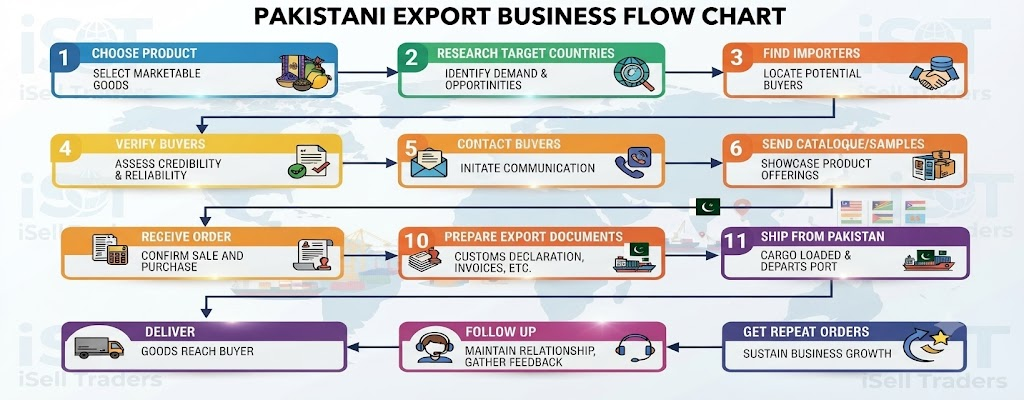
The real objective should therefore be to build a repeatable export sales system.
Your system should look like this:
That is how a small Pakistani trading business can gradually develop into an international export operation.
You do not need to find 10,000 buyers.
You need to find the right buyers.
Start with one product, three countries, and a list of 100 qualified companies. Contact them professionally, record every response, learn from rejection, improve your offer, and continue building relationships.
Over time, those relationships can become regular export orders and long-term international customers.
Useful Official and Industry Resources
For Pakistani exporters, it is useful to keep the following resources bookmarked:
- Pakistan Single Window (PSW) — digital platform for import, export, and transit-related regulatory processes. (Pakistan Standard Wedding)
- Ministry of Foreign Affairs – Commerce & Trade Resources — includes links to TDAP, Pakistan Export Gallery, exporter directories, and international exhibitions. (Ministry of Foreign Affairs)
- Alibaba.com — global B2B marketplace.
- TradeWheel — B2B marketplace with a Pakistan-focused supplier section. (TradeWheel)
- EC21 — international B2B marketplace. (EC21)
Important: B2B marketplaces and trade-data services change their fees, verification systems, available countries, and features. Always check the current terms directly before paying for a subscription or relying on a buyer lead.
Other Useful Links
- How to Start an Import Export Business in Pakistan
- How to Get PSW / WeBOC Registration
- Logistics Services in Pakistan
- Pakistan Budget 2026-27 Major Relief
- How to Start an Ecommerce Business in Pakistan
keywords: textile manufacturers in Pakistan, surgical instruments manufacturers Pakistan, Pakistan export data customs database, how to start export business in Pakistan, leather products wholesale suppliers Pakistan, B2B portals for Pakistani exporters