
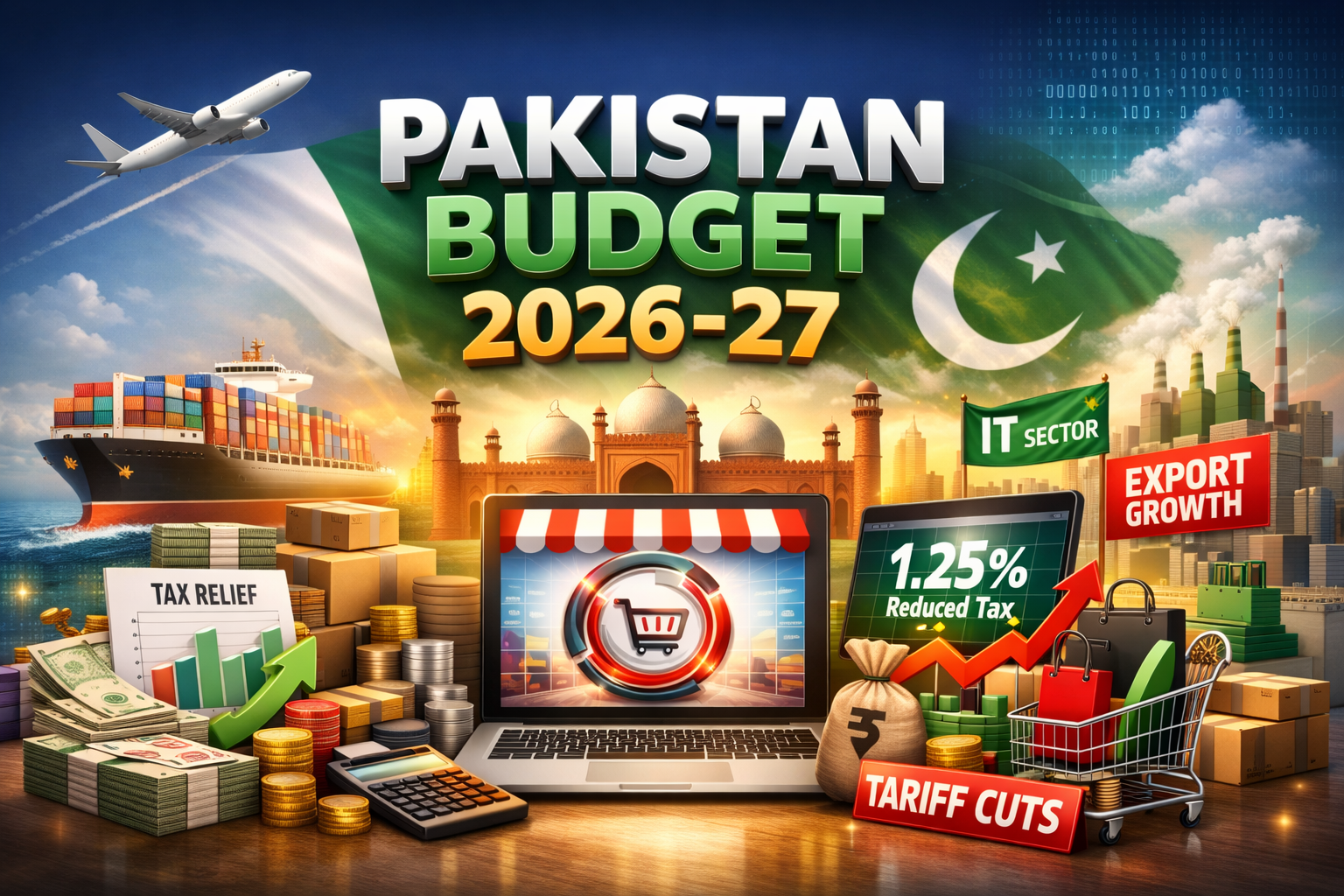

The Pakistan Budget 2026-27 introduces several important reforms aimed at strengthening exports, supporting local industries, reducing business costs, and improving Pakistan’s overall competitiveness in international trade. Furthermore, the government has announced tax relief, customs duty reductions, and financing incentives that are expected to benefit exporters, importers, manufacturers, SMEs, and the growing IT sector.
If implemented effectively, these measures could improve business confidence, encourage investment, and help Pakistan achieve its export-led growth targets. In this article, we summarize the most significant announcements and explain what they mean for the business community.
Export Sector Receives Major Relief
One of the biggest announcements in the Pakistan Budget 2026-27 is the reduction in taxes applicable to export proceeds.
Previously, exporters paid a combined advance and minimum tax of 2% on export proceeds. However, the government has now reduced this to 1.25% as a minimum tax, allowing exporters to retain more working capital and improve cash flow.
In addition, the 0.25% Export Development Surcharge has been abolished, providing further financial relief to export-oriented businesses.
Why This Matters
These measures will:
- Improve exporters’ cash flow
- Increase international competitiveness
- Reduce the overall cost of doing business
- Encourage higher export volumes
Export Finance Scheme Becomes More Affordable
Another major incentive announced in the budget is the reduction in the markup under the Export Finance Scheme (EFS).
The financing rate has been reduced dramatically from 19% to 4.5%, making export financing significantly more affordable for businesses.
This change is expected to help exporters:
- Expand production
- Improve liquidity
- Accept larger export orders
- Invest in business growth
Lower financing costs can particularly benefit small and medium-sized exporters who often struggle with expensive borrowing.
IT Exporters Continue to Receive Tax Incentives
Pakistan’s rapidly growing IT industry has also received positive news.
The concessional 0.25% final tax regime for IT and IT-enabled service exports has been extended until 30 June 2029.
This provides long-term certainty for:
- Software companies
- Freelancers
- IT startups
- Business Process Outsourcing (BPO) companies
- Technology exporters
With Pakistan’s IT exports continuing to grow, this extension is expected to encourage further investment in the digital economy.
Tariff Reforms to Reduce Manufacturing Costs
The government has also continued implementing the National Tariff Policy 2025-30, focusing on reducing production costs for industries.
According to the budget announcements:
- Customs duties have been reduced on 92 industrial input tariff lines.
- Additional Customs Duties (ACD) have been reduced across approximately 3,125 tariff lines.
- Regulatory Duties have been rationalized on around 1,914 tariff lines, with many capped at 20%.
These reforms are expected to provide approximately Rs. 120 billion in relief to businesses.
Expected Benefits
Lower import duties on industrial inputs may help businesses by:
- Reducing production costs
- Improving manufacturing efficiency
- Increasing export competitiveness
- Encouraging investment in local industries
Continued Sales Tax Relief
The budget also extends sales tax exemptions for several important sectors.
Relief has been provided for:
- Electric Vehicle (EV) CKD kits until June 2027
- Aircraft parts
- Refinery capital goods
- Other strategic industrial sectors
These measures are intended to encourage industrial modernization and long-term investment.
Super Tax Relief for Businesses
The government has also announced important changes regarding the Super Tax.
According to the budget:
- Super Tax has been abolished for many businesses with taxable income up to Rs. 500 million (subject to specified exclusions).
- For higher-income businesses, the rate has been reduced from 10% to 8%.
This is expected to reduce the tax burden on many businesses and improve profitability.
New Fixed Tax Scheme for Small Businesses
Small traders and retailers have also received significant attention.
Businesses with annual turnover up to Rs. 200 million may opt for a fixed tax of 1% of turnover, subject to a minimum tax of Rs. 25,000.
Eligible businesses will also benefit from:
- Simplified tax compliance
- Reduced audit exposure
- Easier documentation requirements
This initiative aims to encourage more businesses to enter the formal economy.
Property Transaction Taxes Reduced
To support the construction and real estate sectors, the government has also reduced withholding taxes on immovable property transactions.
The objective is to:
- Stimulate investment
- Increase property market activity
- Support construction-related industries
Focus on Digitalization and Ease of Doing Business
Beyond tax reforms, the Pakistan Budget 2026-27 places strong emphasis on:
- Digital tax systems
- Business documentation
- Improved compliance
- Simplified government procedures
- Greater transparency
These reforms aim to improve Pakistan’s overall business environment while encouraging formal economic activity.
What Does This Mean for Importers?
Although much of the budget focuses on exports, importers also stand to benefit.
Lower customs duties on industrial raw materials and intermediate goods can reduce import costs for manufacturers and businesses.
Importers involved in:
- Industrial machinery
- Manufacturing inputs
- Raw materials
- Production equipment
may experience noticeable cost savings under the revised tariff structure.
Opportunities for SMEs
Small and medium-sized enterprises (SMEs) are likely to benefit from several initiatives, including:
- Lower financing costs
- Reduced tax burden
- Simplified taxation
- Lower production costs
- Improved export competitiveness
These reforms could encourage entrepreneurship and support business expansion across multiple sectors.
Challenges Still Remain
Despite these positive announcements, businesses must also remain aware of ongoing challenges.
Some key concerns include:
- High energy costs
- Logistics and transportation issues
- Inflationary pressures
- Exchange rate fluctuations
- Effective implementation of announced reforms
The success of the budget will ultimately depend on how efficiently these policies are implemented.
Final Thoughts
Overall, the Pakistan Budget 2026-27 sends a positive signal to exporters, importers, manufacturers, SMEs, and investors. Through tax reductions, tariff reforms, cheaper export financing, and support for the IT sector, the government has demonstrated a clear intention to promote export-led growth and improve Pakistan’s business environment.
If these measures are implemented effectively, they have the potential to strengthen Pakistan’s competitiveness, attract investment, and create new opportunities for businesses across the country.
At iSell Traders, we will continue publishing detailed analyses of budget measures, import-export regulations, customs policies, ecommerce developments, and business opportunities to help entrepreneurs stay informed and make better business decisions.
Related Guides
If you’re planning to build an export business, you may also find these guides helpful:
- How to Start an Import Export Business in Pakistan
- How to Get PSW and WeBOC Registration
- Logistics Services for E-Commerce in Pakistan
- How to Start Drop-shipping in Pakistan
- How to Open a Shopify Store in Pakistan