
A Complete Step-by-Step Guide
CusCustoms clearance Karachi Port decides whether your shipment moves smoothly or sits stuck for weeks racking up storage charges. Most delays don’t come from slow customs processing. They come from importers not knowing exactly what’s needed at each stage: which document proves what, how you calculate duty, and what to do when something goes wrong.
This guide walks through the customs clearance process at Karachi Port. You’ll learn every document you need and what each one actually is. You’ll also see the exact steps from arrival to release, how to calculate your duty and tax in advance, and the way-outs for the problems that most commonly hold shipments up.
What Is Customs Clearance, Exactly?
Customs clearance is the legal process of getting goods approved by Pakistan Customs. You must declare every shipment — by sea, air, or land — through WeBOC (Web-Based One Customs), Pakistan’s electronic customs filing system, before customs releases your cargo from a port, terminal, or airport.
Karachi Port and Port Qasim together handle the large majority of Pakistan’s international trade. Pakistan Customs processes clearance through PACCS (Pakistan Customs Computerized System). This system lets you self-assess duties and file your declaration from anywhere in the country — you don’t need to be physically present in Karachi.
Documents You’ll Need — What Each One Actually Is
New importers often get confused about these documents. They don’t know what each one is, who issues it, or when they need it. Here’s each one explained:
Commercial Invoice
Your supplier issues this invoice at the time of sale, before you even ship the goods. It states the price, quantity, and description of your shipment, and usually arrives by email along with your order confirmation. Customs uses this invoice to verify your declared value. A mismatch between your invoice value and what customs assesses as fair market value causes most valuation disputes.
Packing List
Your supplier also issues this document, usually alongside the commercial invoice, before or at shipping time. It details exactly how you’ve packed the shipment — the number of boxes or cartons, weight, dimensions, and contents of each package. Customs officers use it to verify cargo contents during any physical examination, matching what you declared against what’s actually in each carton.
Bill of Lading (Sea Freight) or Airway Bill (Air Freight)
The shipping line issues a Bill of Lading (for sea freight) or the airline issues an Airway Bill (for air freight) once your cargo loads onto the vessel or aircraft. Your freight forwarder or shipping line sends this to you after departure. It acts as proof of shipment, and for sea freight, often also serves as a document of title to the goods. You can’t file your Goods Declaration in WeBOC without this document’s reference number.
Certificate of Origin
A Chamber of Commerce or relevant trade body in the exporting country issues this certificate, arranged by your supplier before or at shipment. It certifies which country manufactured the goods. Origin affects your duty rate — for example, you may qualify for reduced rates under the Pakistan-China Free Trade Agreement. Without this certificate, you may pay a higher standard duty rate even if you’d otherwise qualify for a lower one.
Import/Export License or Registration
You set this up once, before your first shipment — not per shipment. It’s your business’s registration to legally import or export, tied to your NTN (National Tax Number) and WeBOC user ID. Without an active WeBOC registration linked to your NTN, you can’t file a Goods Declaration at all.
Letter of Credit or Proof of Payment
You arrange this through your bank before or during the transaction. It’s banking documentation proving how you paid — either a Letter of Credit (a bank-guaranteed payment arrangement common in larger trade deals) or a simpler bank transfer or payment receipt. Customs and the State Bank of Pakistan use this to verify that the transaction value matches what actually left or entered the country financially.
Product-Specific Approvals
You arrange these with the relevant regulatory body before shipment — for example, DRAP for pharmaceuticals, or the Punjab/Sindh Food Authority for food items. These are additional regulatory certificates required for specific product categories, such as health and safety certificates for pharmaceuticals, food safety clearance for edible goods, or hazardous materials documentation for chemicals. Goods in these categories won’t clear customs without the specific approval for that product type, no matter how complete your other paperwork is.
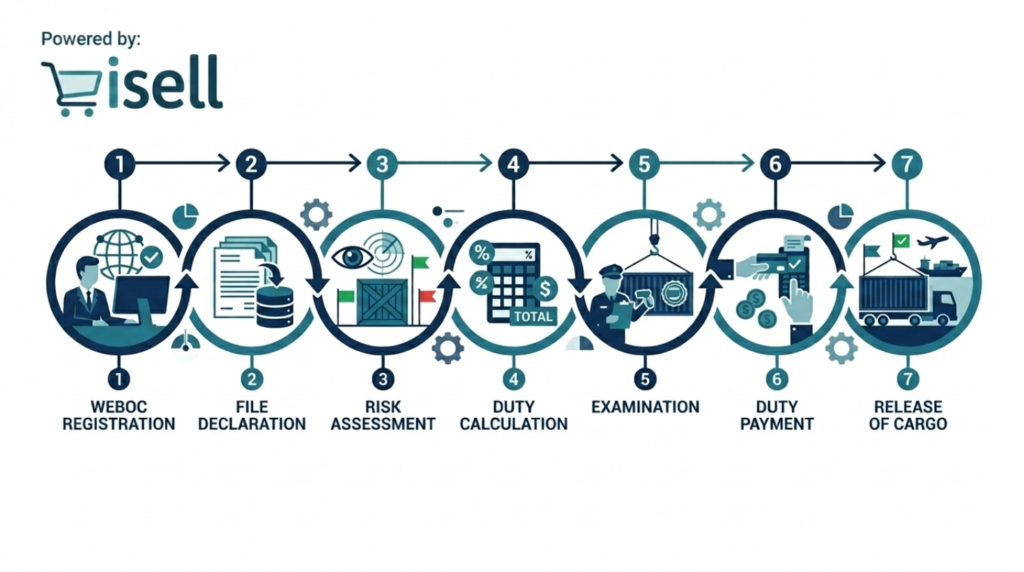
The Customs Clearance Process, Step by Step
Step 1: Get WeBOC-Registered (One-Time Setup)
Register on the WeBOC system before your first shipment, and link your registration to your NTN. If you’re new to import-export, a customs agent typically handles this for you, or you can register directly through the WeBOC portal.
Step 2: File the Goods Declaration (GD)
Once your shipment is en route, your customs agent files a Goods Declaration electronically through WeBOC, using details from your Commercial Invoice, Packing List, and Bill of Lading or Airway Bill. This declares the goods, their value, quantity, and HS (Harmonized System) code — the classification code that determines your applicable duty rate.
Step 3: Risk Assessment (Automatic)
PACCS automatically risk-assesses your declaration. The system fast-tracks shipments with clean, consistent documentation through a “green channel.” It routes shipments with inconsistent values, high-risk product categories, or incomplete paperwork to scanning or physical examination through a “red channel.”
Step 4: Duty and Tax Assessment — and How to Calculate It Yourself
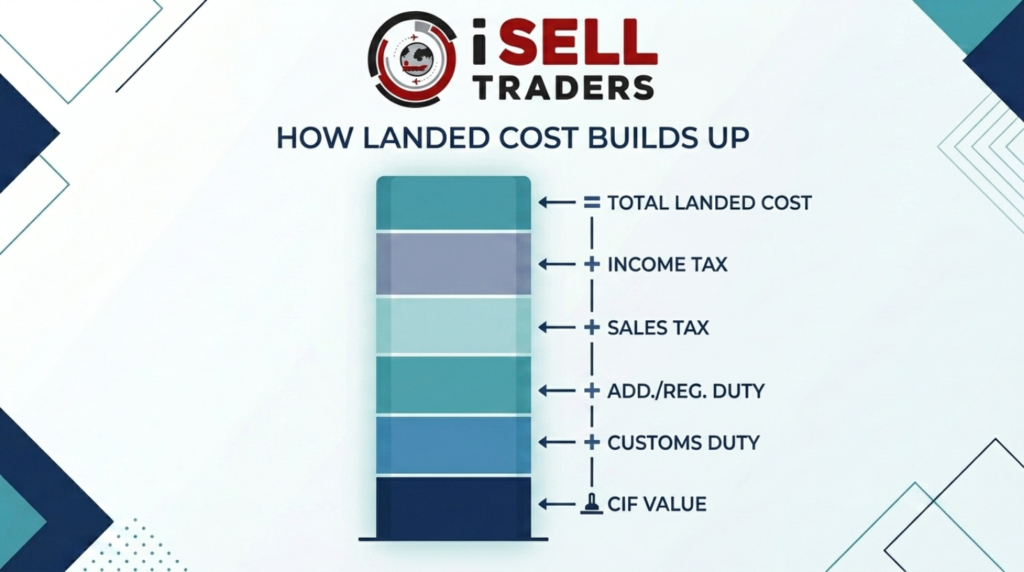
Most importers find this step confusing, but it follows a consistent formula. You can estimate it yourself before your shipment even arrives:
- Find your HS Code. Every product has a unique Harmonized System code (for example, 6109.10.00 for a cotton t-shirt). Look this up on the FBR’s official Pakistan Customs Tariff, or ask your supplier or customs agent. Getting this wrong leads to an incorrect duty estimate and possible disputes.
- Calculate your CIF value. This means Cost + Insurance + Freight, converted to PKR at the customs exchange rate — not just your product cost. Example: $1,000 goods + $150 freight + $20 insurance = $1,170 CIF.
- Apply the Customs Duty (CD) rate for your HS code to the CIF value.
- Add Additional Customs Duty (ACD) and Regulatory Duty (RD) if they apply to your product category. Calculate these on the CIF value too.
- Add Sales Tax (currently around 17–18%) on the CIF value plus the duties above.
- Add Advance Income Tax. This varies depending on whether you’re an active taxpayer (filer) or not — non-filers pay a noticeably higher rate.
Way out: You don’t have to do this math manually or guess. The FBR runs an official Customs Duty Calculator directly on its website (fbr.gov.pk). Enter your HS code, CIF value, and quantity, and it returns a full breakdown of payable duty and tax based on official current rates. Several independent tools, like ClearAgent and TaxToday Pakistan, offer the same calculation with a simpler interface, pulling from official FBR tariff data. These work well for a quick estimate before you commit to an order, though your customs agent’s final assessment is what actually counts at clearance.
Step 5: Examination (If Flagged)
If customs selects your shipment for physical examination, officers check the cargo against your declared documents — particularly the Packing List. A mismatch here — wrong quantity, undeclared items, or a different product than stated — triggers a lengthy investigation fastest, and can lead to fines or, in serious cases, seizure of goods.
Step 6: Duty Payment
Pay your assessed duties and taxes at any authorized bank in Pakistan — you don’t need to pay in person in Karachi. Your payment links to your Bill of Lading or Airway Bill number.
Step 7: Release of Cargo
Once you pay duties and clear examination (if required), customs issues a release order. Your transporter can then pick up your goods from the port or terminal and move them to their final destination.
Way-Outs for the Most Common Problems
Problem: Customs disputes your declared value
Pakistan Customs offers a formal review mechanism. If you disagree with the assessed value, request a First Review. If you still can’t resolve it, request a Second Review before the Assistant Collector, who issues a formal written order. You can escalate disputes further to Collector Appeals and, ultimately, the Appellate Tribunal. Keep all original supplier communication and payment proof on hand — this gives you your strongest evidence in a valuation dispute.
Problem: Customs selects your shipment for physical examination
This doesn’t necessarily signal a red flag. PACCS randomly examines a percentage of shipments regardless of risk profile. Way out: make your Packing List precise down to the carton, and stay reachable through your customs agent so you can answer any clarification request the same day. Unanswered queries turn a routine check into a prolonged hold.
Problem: You’re missing a product-specific approval
Way out: check regulatory requirements for your product category before you ship, not after arrival. Approvals from bodies like DRAP (pharmaceuticals) or food authorities can take days to weeks, and you can’t fast-track them once your cargo sits at the port accumulating storage charges.
Problem: Customs challenges your HS code classification
Way out: if customs disagrees with your declared HS code, you can request a review, but prevention works faster. Use the FBR’s HS Transposition Table or a licensed customs agent to confirm classification before filing, especially for products that could reasonably fall under more than one code.
Should You Use a Customs Clearing Agent?
You can technically file your own Goods Declaration through WeBOC. In practice, most importers — especially those newer to trade — work with a licensed customs clearing agent. A good agent stays current on HS code classifications and regulatory changes, and responds the same day if customs flags a shipment. For businesses shipping regularly, an agent’s fee almost always costs less than even a few days of storage-charge delays.
Final Thoughts
Customs clearance Karachi Port isn’t inherently complicated. WeBOC and PACCS work efficiently, and most shipments move through in days, not weeks. Businesses actually lose time and money in the preparation stage: an unclear invoice, a missing approval, or an HS code nobody double-checked. Get your paperwork right before your shipment departs, calculate your duty in advance using the FBR’s official calculator, and clearance becomes a formality rather than a bottleneck.