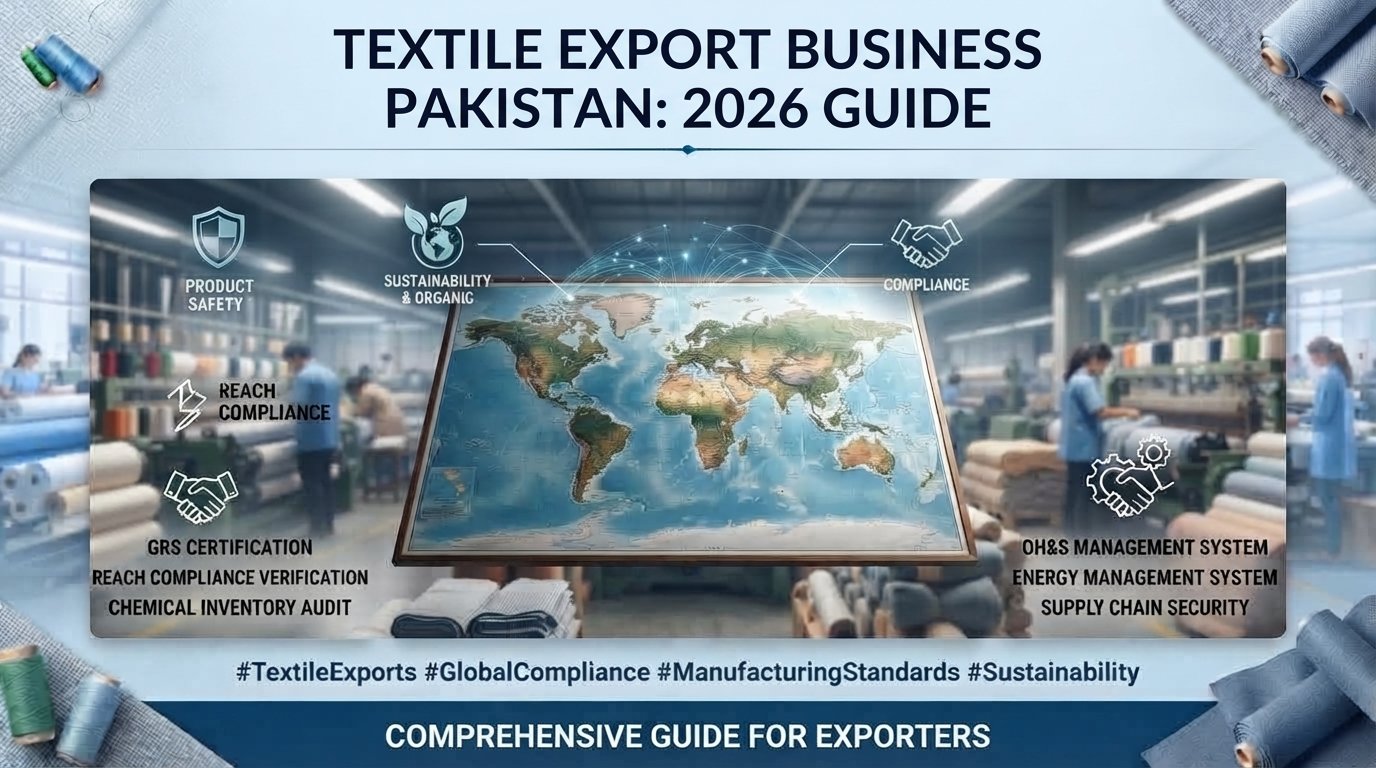

Textile export business Pakistan opportunities currently rest on one major advantage: the EU’s GSP+ trade scheme. Pakistan is the world’s largest beneficiary of GSP+, and textiles make up roughly 70% of everything Pakistan sells into Europe. However, the rules are changing from 2027 onward, so timing and compliance both matter more than ever. This guide covers how to start, what certifications you’ll need, and what’s shifting in the next few years.
Why Textile Export Business Pakistan Opportunities Are Growing
Pakistan’s exports to the EU reached $8.96 billion in 2025-26. Clothing alone accounts for about 95% of GSP+ preference utilisation within Pakistan’s EU trade. In other words, almost every eligible clothing shipment already claims its duty-free benefit. As a result, textiles remain Pakistan’s single largest export industry, employing millions of people directly and indirectly.
Demand keeps rising too. Textile exports to the EU alone grew by more than 20% year-on-year in a recent reporting period, driven by both GSP+ access and growing European demand for Pakistani textiles. For a new exporter, this means real, proven buyer demand already exists. You don’t need to create a market from scratch.
How to Start a Textile Export Business in Pakistan
The registration steps overlap with any export business, but textile exporters need a few sector-specific additions.
Step 1: Register Your Company and Get Your NTN
Start with standard business registration. Most exporters choose SECP registration for liability protection, then register separately for their NTN with the FBR. Our SECP company registration guide and NTN registration guide cover both processes in full.
Step 2: Complete PSW/WeBOC Registration
Every exporter needs WeBOC registration to clear customs and file shipments through Pakistan’s single-window system. If you haven’t done this yet, our PSW/WeBOC registration guide walks through the full process.
Step 3: Join the Right Industry Association
Textile exporters typically join a sector-specific body rather than just a general chamber of commerce. Which one depends on what you actually produce, covered in the table below.
Step 4: Secure Buyer-Required Certifications
International buyers, especially in the EU, now expect documented compliance before they’ll place an order. We cover the main certifications in the next section.
Step 5: Arrange Freight and Customs Clearance
Once you have orders, you’ll need a freight forwarder and a customs clearing agent. Our air freight vs sea freight guide and customs clearance guide explain how shipments actually move from Pakistan to your buyer.
Key Industry Associations for Textile Exporters
| Association | Best Fit For |
|---|---|
| APTMA (All Pakistan Textile Mills Association) | Spinning and weaving mills |
| PRGMEA (Pakistan Readymade Garments Manufacturers and Exporters Association) | Garment and apparel exporters |
| PTEA (Pakistan Textile Exporters Association) | General textile exporters |
| APBUMA (All Pakistan Bedsheets & Upholstery Manufacturers Association) | Home textile and bedsheet exporters |
| PTC (Pakistan Textile Council) | Policy advocacy and industry-wide representation |
Certifications You’ll Likely Need for Textile Export Business in Pakistan
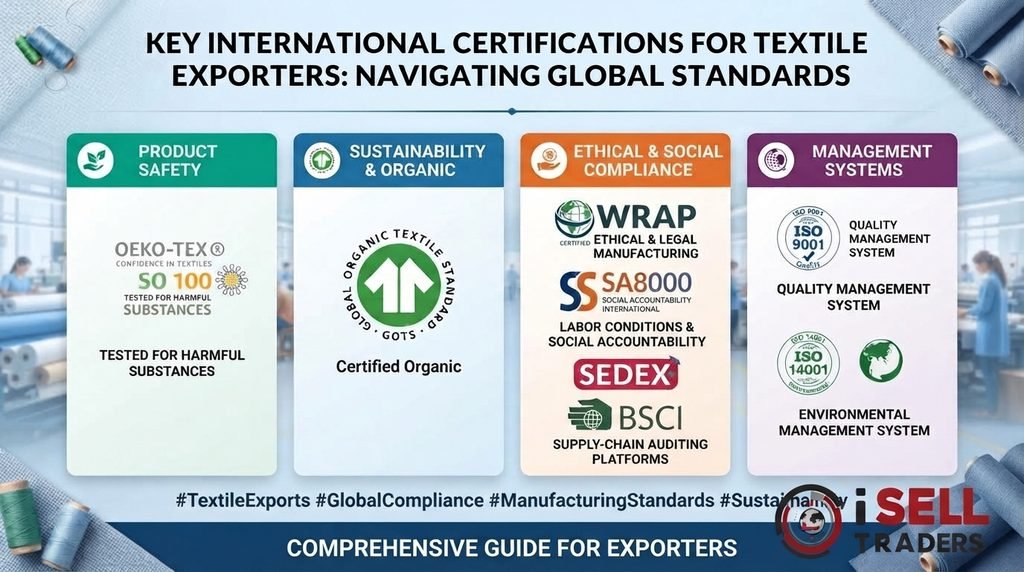
EU and Western buyers increasingly require documented proof of quality, safety, and ethical production before they’ll sign a contract. Common certifications in Pakistan’s textile export sector include:
- OEKO-TEX 100 — tests for harmful substances in finished textile products
- GOTS (Global Organic Textile Standard) — required if you’re exporting organic cotton products
- WRAP (Worldwide Responsible Accredited Production) — certifies ethical and legal manufacturing practices
- SA8000 — a social accountability standard covering labour conditions
- SEDEX and BSCI — supply-chain auditing platforms many European retailers require
- ISO 9001 and ISO 14001 — quality management and environmental management systems
You don’t need every certification on day one. Instead, ask your target buyers which ones they actually require, since requirements vary by market and product category.
New EU GSP+ Rules Exporters Should Watch
The EU adopted a revised GSP regulation in May 2026, which will govern the scheme from 2027 through 2036. This matters directly for textile export business Pakistan planning, for a few reasons.
First, the new framework introduces safeguard measures specifically for textiles. If Pakistan’s textile imports into the EU exceed 6% of total EU imports in a category, or 47% of imports from all GSP beneficiary countries combined, safeguard measures can apply. This places a real ceiling on how much growth the sector can absorb before facing new restrictions.
Second, compliance scrutiny is getting sharper. Mills, garment exporters, and home-textile suppliers will need stronger documentation on labour standards, environmental practices, and traceability going forward. If you’re building a textile export business now, build your compliance paperwork habits early, since buyers will expect them regardless of what the EU formally requires.
Common Mistakes New Textile Exporters Make
Skipping Certification Research
Many new exporters assume one certification covers every buyer. In reality, different markets and retailers ask for different standards, so always confirm requirements before investing in certification.
Ignoring Association Membership
Associations like PRGMEA and PTEA provide market access, trade show opportunities, and policy updates you won’t find elsewhere. Skipping membership means missing real buyer connections.
Underestimating Compliance Costs
Certification and compliance audits cost money and take time. Budget for these early instead of treating them as an afterthought once a buyer asks for proof.
Frequently Asked Questions about textile export business in Pakistan
Do I need a factory to start a textile export business in Pakistan?
Not necessarily. Many exporters work as trading or sourcing companies, placing orders with existing mills and garment factories rather than owning production themselves.
Which certification should I get first?
OEKO-TEX 100 is the most commonly requested starting point for finished textile products, since it covers harmful substance testing that most buyers check for by default.
Is GSP+ access guaranteed to continue?
Pakistan currently holds strong GSP+ status, but the EU’s revised framework introduces stricter compliance checks from 2027 onward. Staying informed on labour and environmental documentation protects your long-term access.
Final Thoughts about Textile Export Business Pakistan
Textile export business Pakistan opportunities remain genuinely strong, backed by real GSP+ demand and billions of dollars in existing EU trade. Register your business properly, join the association that fits your product, and start building certification documentation early. For the logistics side once you have orders flowing, see our guides on international courier services and export packaging and labeling.