

SBP Small Business Loans: Complete Guide to Schemes
SBP small business loans give Pakistani entrepreneurs real access to financing, even without full collateral. The State Bank of Pakistan runs several targeted schemes specifically designed to reduce the barriers small businesses face when applying for bank credit. This guide covers what’s actually available, who qualifies, and how to apply.
Why SBP Small Business Loans Exist
Pakistan has around 5.2 million SMEs, forming the backbone of the economy. However, formal bank credit to this sector has historically stayed low compared to overall private lending. As a result, the State Bank of Pakistan introduced targeted refinancing and credit guarantee schemes to close this gap.
Banks have traditionally required full collateral before lending to small businesses. Because many entrepreneurs can’t offer this, SBP now partially guarantees bank losses on qualifying SME loans. This mechanism has genuinely expanded unsecured lending, making financing realistic for businesses that couldn’t access it before.
Key SBP Small Business Loans Schemes to Know
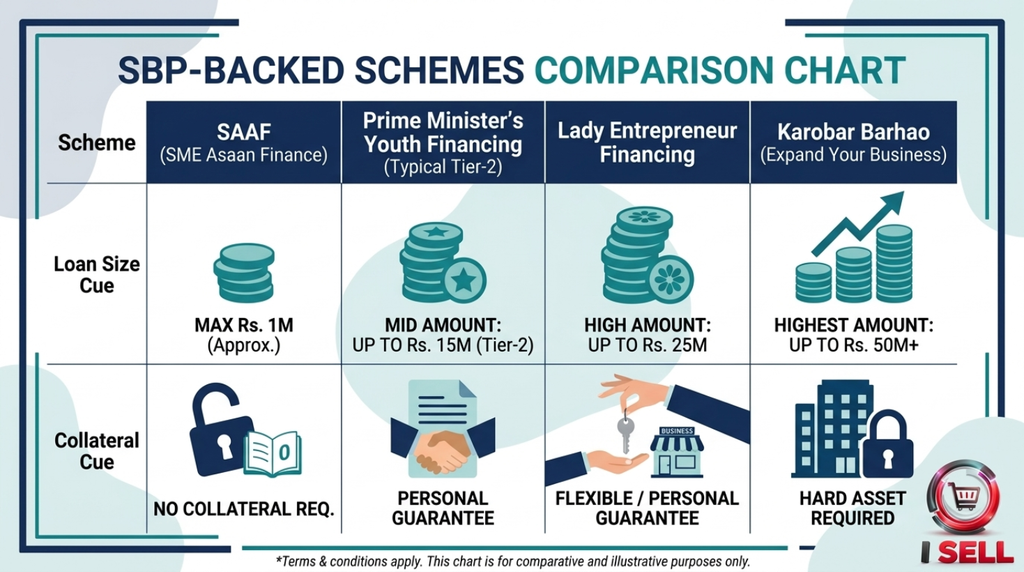
SME Asaan Finance (SAAF) is the flagship collateral-free scheme. It works as a refinance and credit guarantee facility, letting creditworthy SMEs borrow without pledging security. Financing under SAAF caps at PKR 10 million per business, covering both term loans and working capital financing. Processing generally takes up to 30 days once you submit complete documentation.
Prime Minister’s Youth Business and Agriculture Financing Scheme targets unemployed youth specifically, offering self-employment financing in collaboration with SBP. This scheme suits younger entrepreneurs starting their first business venture.
Lady Entrepreneur Financing Scheme, offered through several banks including the Bank of Punjab, focuses on women-owned businesses. Loan amounts here run smaller — typically PKR 10,000 to PKR 500,000 — with faster approval timelines, often within one week.
Karobar Barhao Scheme and similar bank-specific SME products offer larger financing amounts (up to PKR 50 million in some cases), though these typically require collateral rather than operating on a clean-lending basis.
Understanding SME Classification
SBP classifies businesses into Small and Medium categories based on annual sales turnover, and this classification determines which schemes and benefits apply to you. Most SBP-backed schemes use this threshold as their entry point, so confirming which category your business falls into is a useful first step before applying anywhere.
How to Apply: Step by Step
- Confirm your SME classification based on your annual turnover, since this determines your eligibility for specific schemes.
- Choose the right scheme based on your business type, financing need, and whether you can offer collateral.
- Use the Standardized Loan Application Form, introduced under SBP guidelines specifically to simplify SME applications. This single form now lets you apply across multiple participating banks.
- Gather required documentation, including business registration, financial records, and identification documents. Banks are required to provide you a clear document checklist at the time of application.
- Submit your application at a participating bank branch offering your chosen scheme.
- Wait for processing, which varies by scheme — anywhere from one week for smaller lady-entrepreneur products to around 30 days for SAAF.
Common Problems and How to Handle Them
Problem: You don’t have collateral to offer.
Way out: this is exactly what SAAF exists to solve. Look specifically for banks offering SAAF or other clean-lending SBP-backed products, since these are structured around SBP’s partial credit guarantee rather than requiring your own security.
Problem: Your business’s informal bookkeeping makes documentation difficult.
Way out: start organizing basic financial records now, even simple ones, since irregular bookkeeping is one of the most common reasons SME loan applications stall. Banks need to see consistent records to assess your application properly.
Problem: You’re not sure which specific scheme fits your situation.
Way out: your business type, gender, age, and collateral availability all narrow down realistic options quickly. A quick conversation with an SME banking officer at a participating bank often clarifies this faster than researching every scheme independently.
Problem: You applied to one bank and got rejected.
Way out: the Standardized Loan Application Form exists specifically so you don’t need to restart your paperwork from scratch at a different bank. Different banks assess risk differently, so a rejection at one doesn’t necessarily mean rejection everywhere.
Final Thoughts on SBP Small Business Loans
SBP small business loans genuinely open real financing options for entrepreneurs who couldn’t access bank credit before, particularly through collateral-free schemes like SAAF. Identify your SME classification, match your situation to the right scheme, and get your documentation organized before applying. These schemes exist specifically to bring more small businesses into the formal financial system, and using them properly can meaningfully change what’s possible for your business.
Suggested internal links (add where relevant):
- SECP Company Registration Pakistan
- Shopify Store in Pakistan
- Start an E-commerce Business in Pakistan
- Free Tools for Pakistani E-commerce Sellers
Suggested external links (authoritative sources):
Tags: SBP small business loans, SME Asaan Finance scheme, collateral-free loans Pakistan, Lady Entrepreneur Financing Scheme, SBP refinance schemes, small business financing Pakistan, SME loan eligibility Pakistan, Prime Minister Youth Business Loan, Karobar Barhao Scheme, business loan application Pakistan