

Income Tax Freelancers Pakistan: Complete 2026 Filing Guide
Income tax freelancers Pakistan rules split into two genuinely different paths, depending on where your clients are based. Get the wrong path applied to your income, and you either overpay significantly or risk falling out of compliance. This guide breaks down exactly which rules apply to you, the current 2026 rates, and how online sellers fit into the picture too.
The Two Income Tax Freelancers Pakistan Pathways
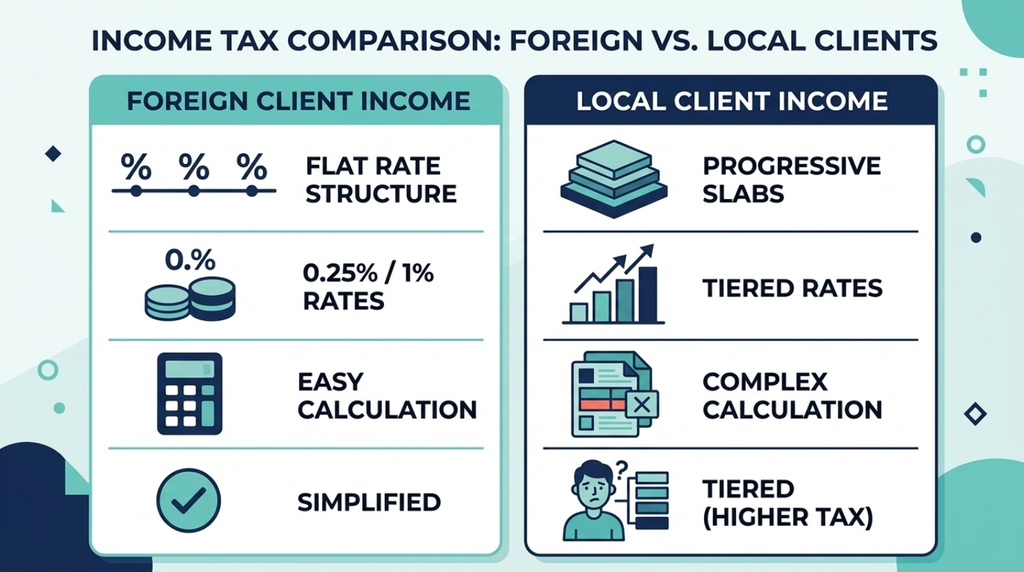
If you earn foreign income — from Upwork, Fiverr, or direct international clients — your earnings qualify as IT export income under Section 154A of the Income Tax Ordinance. This income gets taxed at a flat final rate, not the standard progressive slabs. PSEB-registered freelancers pay just 0.25%. Non-PSEB freelancers pay 1%. Either way, this counts as your final tax on that income, with no further slab-based tax on top.
If your clients are based inside Pakistan and pay you in PKR through local banking, different rules apply. Your net income falls under the standard progressive income tax slabs instead. Local clients that are companies must withhold 10% tax under Section 153 on payments to you, which then gets credited against your final calculated liability.
The 80% Rule for Foreign Income
To actually qualify for the reduced 0.25% or 1% rate on foreign income, at least 80% of it must arrive in Pakistan through approved banking channels — Payoneer, Wise, SWIFT wire, or a platform’s direct bank transfer — within the tax year. Money sitting indefinitely in PayPal, or received through unofficial channels, doesn’t count toward this threshold and won’t qualify for the reduced rate.
What About Sales Tax for Online Sellers?
Sales tax registration only becomes mandatory once your annual taxable turnover crosses PKR 10 million. Most individual freelancers and smaller online sellers never reach this threshold, so sales tax registration usually isn’t a concern in the early stages of a business.
However, the Finance Act 2026 brought e-commerce platforms and online sellers more firmly into the withholding tax framework than before. If you’re running a growing online store rather than freelancing individually, it’s worth checking current FBR guidance specifically for digital sellers, since these rules have shifted meaningfully in recent budget cycles.
Tax-Free Threshold and Who’s Actually Exempt
Individuals earning below PKR 600,000 annually remain fully exempt from income tax. This applies to freelancers just as it does to any individual taxpayer.
However, exemption from tax doesn’t mean you should skip registration entirely. Voluntary registration and appearing on the Active Taxpayer List (ATL) unlocks real benefits even below the exemption threshold — lower withholding rates on banking transactions, and fewer restrictions on buying property or vehicles.
How to Handle Income Tax Freelancers Pakistan Registration: Step by Step
- Visit the FBR IRIS portal (iris.fbr.gov.pk) and register as an Individual — Freelancer/Professional.
- Provide your CNIC, email, and mobile number. Your NTN typically links directly to your CNIC.
- Complete registration, which is fully digital and usually takes 1–3 working days, with no registration fee.
- Register with PSEB separately, if your foreign income qualifies as IT-enabled services, to unlock the reduced 0.25% rate.
- Track your income by source throughout the year — foreign export income and local PKR income need separate treatment at filing time.
- Submit your annual return by the deadline. Multiple sources confirm the individual filing deadline as September 30, so treat this as the safe date to target, and always cross-check the FBR’s current notification each year since deadlines occasionally shift.
Common Problems and How to Handle Them
Problem: You’re not sure which tax path applies to a specific client’s payment.
Way out: the deciding factor is where the client is based and how they pay you, not what kind of work you do. A foreign client paying through Payoneer falls under the export income rules; a Pakistani client paying in PKR through a local bank falls under standard progressive slabs.
Problem: A US client withholds 30% tax on your payment.
Way out: submit Form W-8BEN on Upwork or Fiverr, including your NTN. This reduces US withholding to 0% under the Pakistan-US tax treaty, and it’s a one-time setup rather than something you repeat per payment.
Problem: You’ve been letting foreign income sit in PayPal or an informal channel.
Way out: move your income through an approved formal channel as soon as possible, since only formally documented inflows count toward the 80% threshold that unlocks your reduced tax rate.
Problem: You earn below the exemption threshold and assume you don’t need to register at all.
Way out: register anyway. ATL status brings real financial benefits even when your actual tax liability is zero, and building a compliance history early makes things easier once your income grows past the threshold.
Final Thoughts on Income Tax Freelancers Pakistan
Income tax freelancers Pakistan rules genuinely reward the freelancers who set things up correctly from the start. Identify which income path applies to each client relationship, register with both FBR and PSEB where relevant, and route your foreign income through approved banking channels consistently. Get these fundamentals right, and tax season becomes a filing formality rather than a scramble.
Suggested internal links (add where relevant):
Suggested external links (authoritative sources):
- PSEB Registration Pakistan
- Receive International Payments Pakistan
- NTN and Sales Tax Registration for Import Export Pakistan
Tags: income tax freelancers Pakistan, FBR filing deadline 2026, PSEB 0.25% tax rate, active taxpayer list Pakistan, online seller sales tax Pakistan, Section 154A tax, freelancer NTN registration, W-8BEN Pakistan freelancer, Finance Act 2026 Pakistan, freelancer tax exemption Pakistan


