


PSEB Registration Pakistan: Complete Guide for IT Freelancers
PSEB registration Pakistan is one of the most overlooked steps freelancers take, and it can genuinely save you real money. The Pakistan Software Export Board, established in 1995 under the Ministry of IT and Telecommunications, officially recognizes you as a legitimate IT exporter. In return, you unlock a significantly reduced tax rate and real government support.
This guide covers exactly what PSEB registration Pakistan involves, who qualifies, the documents you need, and the step-by-step process to get registered in 2026.
Why PSEB Registration Pakistan Matters for Freelancers
Without PSEB registration, freelancers pay a 1% withholding tax on foreign income. Once registered, that rate drops to just 0.25% under Section 154A — a meaningful difference once your export earnings grow. Some freelancers may also qualify for a full exemption under Section 65F, though this specific provision’s future depends on ongoing Finance Act extensions, so it’s worth checking current FBR notifications before relying on it.
Beyond the tax benefit, PSEB registration adds real credibility to your freelancing profile. It gives you access to free government training programs (including AI and cloud skills), listing on the Tech Destination Portal for international discoverability, and eligibility for the Roshan IT-Export Account for smoother foreign remittances.
Who Qualifies for PSEB Registration?
PSEB registration covers IT and IT-enabled services (ITeS) broadly. This includes freelancers offering:
- Software and web development
- SEO and digital marketing
- Video editing and animation
- Social media marketing
- Remote accounting and bookkeeping
- Data analysis and related services
If you earn foreign income through Upwork, Fiverr, direct clients, or your own website in any of these categories, you likely qualify. Telecom and media businesses — like mobile operators or cable/internet providers — don’t qualify for PSEB registration under current rules.
Documents You’ll Need
- Valid NTN (National Tax Number) — if you don’t have one, register free at iris.fbr.gov.pk first, since PSEB registration assumes you’re already in the tax system
- CNIC
- Proof of freelance work (client contracts, invoices, or platform earnings history)
- Bank account details for receiving foreign remittances
How to Register: Step by Step
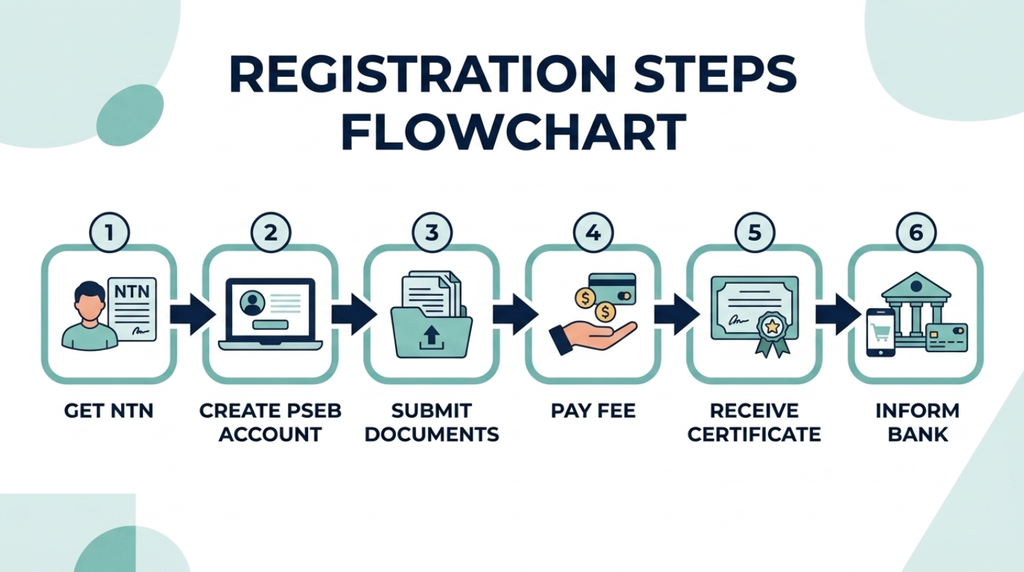
- Get your NTN first, if you don’t already have one. This takes 24–48 hours through the FBR IRIS portal using your CNIC.
- Create an account on the official PSEB registration portal (registration.pseb.org.pk).
- Select Freelancer Registration as your category.
- Fill in your details, including your NTN, CNIC, and business information.
- Submit your required documents, including proof of your freelance work.
- Pay the registration fee — currently around PKR 1,000 for freelancers.
- Wait for processing, which typically takes 5–10 working days.
- Receive your PSEB Registration Certificate digitally once your application is approved.
- Inform your bank. Submit your certificate to your bank so future foreign remittances get coded correctly and taxed at the reduced 0.25% rate instead of the default 1%.
The 80% Rule You Need to Know
To actually qualify for the reduced tax rate, at least 80% of your foreign earnings must come into Pakistan through approved banking channels — a Pakistani bank account, Payoneer linked to a local account, or Wise transfers. This isn’t just a tax requirement. It’s also State Bank of Pakistan policy for documenting foreign exchange inflows.
For example, if you earn $1,500 from Upwork in a month, at least $1,200 of that needs to flow through one of these approved channels to keep your reduced rate intact.
Common Problems and How to Handle Them
Problem: You’re not sure if your NTN is required before PSEB registration.
Way out: yes, it’s mandatory. Even freelancers who believe their income might be exempt still need an NTN, since it’s required for other steps too — including the W-8BEN form that prevents US clients’ payments from facing 30% withholding tax.
Problem: Your bank is still taxing your remittances at 1% after PSEB registration.
Way out: registration alone doesn’t automatically update your bank’s tax coding. You need to actively submit your PSEB certificate to your bank so they apply the correct 0.25% rate going forward.
Problem: You’re close to the 80% banking channel threshold but not quite meeting it.
Way out: review which platforms and payment methods you’re actually using. Payments received through informal channels don’t count toward this rule, so shifting even a portion of your client payments to Payoneer, Wise, or direct bank transfer can make the difference.
Problem: You’re unsure whether your specific freelancing niche qualifies.
Way out: most digital services — writing, design, development, marketing, virtual assistance — fall under IT-enabled services and qualify. If you’re still unsure, PSEB’s own eligibility criteria are published on their official portal and worth checking directly for your specific case.
Final Thoughts on PSEB Registration Pakistan
PSEB registration Pakistan costs a small annual fee and takes about a week to process, but the tax savings alone usually justify it once your foreign income grows past a modest level. Get your NTN sorted first, gather your documents, and register early — leaving this money on the table each year adds up more than most freelancers realize.
Suggested internal links (add where relevant):
Suggested external links (authoritative sources):
Tags: PSEB registration Pakistan, PSEB freelancer registration, IT export tax Pakistan, Section 65F exemption, 0.25% withholding tax freelancers, Pakistan Software Export Board, freelancer tax Pakistan, IT freelancer benefits Pakistan, Roshan IT-Export Account, NTN registration freelancers




I found their sourcing and trading information quite useful
Very Helpful
This website is wonderful. Contains everything