

Freelancing vs E-commerce Pakistan
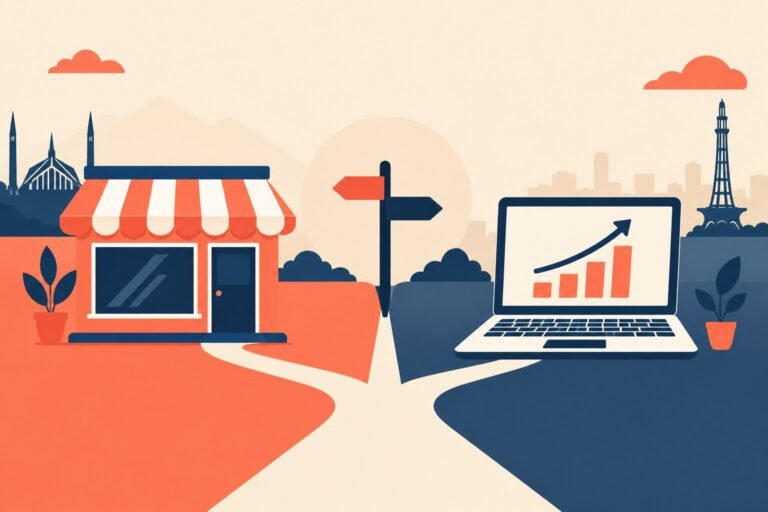
Freelancing vs e-commerce Pakistan is one of the most common questions new entrepreneurs ask. Both paths genuinely work. However, they work in very different ways, with different risks, timelines, and skill requirements. This guide compares the two honestly, using real income data and startup cost differences, so you can pick the path that actually fits your situation.
Freelancing vs E-commerce Pakistan: Startup Costs Compared
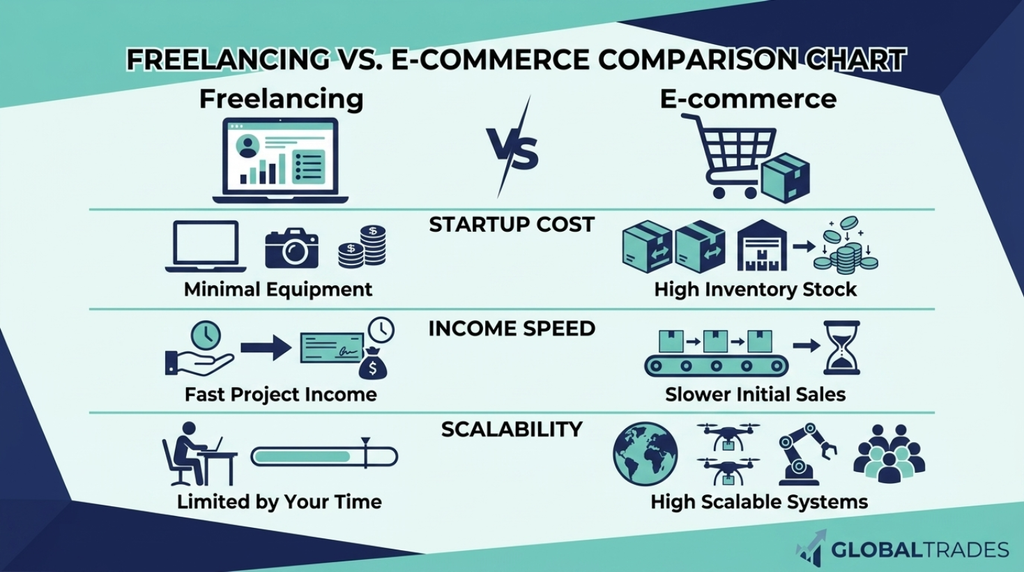
Freelancing has the lowest possible barrier to entry. You need a skill, a laptop, and internet access. Beyond that, your only real investment is time spent building a portfolio and reputation on platforms like Fiverr, Upwork, or Freelancer.com.
E-commerce requires more upfront capital. Even a low-investment dropshipping model typically needs PKR 25,000–60,000 to get started, covering ads, a basic website or platform fees, and initial testing costs. A print-on-demand or inventory-based store can require even more, depending on your product category.
Income Potential: What the Numbers Actually Show
Pakistan’s freelancing sector has grown into a genuine export economy. It generated over $396 million in FY2021–22, and remittances are projected to exceed $530 million by FY2024–25. Pakistan now has over 2.3 million active freelancers, and the country consistently ranks among the top five freelancing nations globally.
Income varies sharply by skill. Accessible categories like basic content writing or data entry earn modest amounts, since these niches have become crowded and partly automated. In contrast, high-demand fields — including AI-assisted services, web development, and SEO — can earn freelancers several times more, with some going from PKR 50,000 in their first month to PKR 200,000 within six months once they build a reputation.
E-commerce income potential varies just as widely. Pakistan’s e-commerce market is growing at roughly 12.5% annually. Profit margins depend heavily on your product category, sourcing costs, and marketing efficiency. Unlike freelancing, e-commerce income isn’t capped by your personal hours — a well-running store can scale without you personally doing more work per sale, which freelancing generally can’t offer.
Risk and Stability: The Real Trade-Off
Freelancing carries lower financial risk, since you’re not holding inventory or spending on ads before earning anything. However, it carries income instability early on — client acquisition takes time, and a slow month often means literally no income that month, since you’re trading time for money directly.
E-commerce carries more upfront financial risk. Ad spend, inventory, or platform fees can go out before a single sale comes in. However, once a store finds a working product and marketing formula, it can generate income even while you’re not actively working — something freelancing structurally cannot do, since your income stays tied to hours billed.
Which One Should You Actually Choose?
Use this quick framework:
- Limited starting capital, want income fastest? → Freelancing, since you can start earning within weeks with zero upfront spend.
- Have some capital to risk and want to build something that scales beyond your own hours? → E-commerce.
- Want to test the waters with minimal risk first? → Start freelancing, and use your first earnings to fund an e-commerce experiment later.
- Have a specific in-demand skill (web development, AI-assisted services, design)? → Freelancing likely gets you to solid income faster than starting a store from scratch.
Many successful Pakistani entrepreneurs don’t actually choose one permanently. They start with freelancing for immediate income, then reinvest earnings into an e-commerce venture once they have capital and market knowledge to work with.
Common Problems and How to Handle Them
Problem: You’ve been freelancing for months with inconsistent income.
Way out: check your positioning first. Generic services in crowded niches — like basic content writing or plain data entry — have seen rates drop sharply as competition and automation increase. Specializing in a higher-demand niche, or combining AI tools into your service offering, often unlocks noticeably better rates.
Problem: Your e-commerce store isn’t profitable despite steady sales.
Way out: revisit your actual margins, not just your revenue. High sales volume with thin margins can leave you with less real profit than a smaller, higher-margin freelancing income — run the numbers honestly before assuming more sales automatically means more profit.
Problem: You’re not sure you have a marketable freelancing skill yet.
Way out: skills like AI automation, web development, and digital marketing currently have the highest earning ceilings in Pakistan, and most can be learned within a few months of consistent practice. Thirty minutes of focused daily practice tends to build real skill faster than occasional long sessions.
Problem: You want to try both but don’t know where to start.
Way out: start with freelancing first, since it needs less upfront capital and teaches you digital skills — client communication, marketing basics, pricing — that transfer directly into running an e-commerce business later.
Final Thoughts on Freelancing vs E-commerce Pakistan
Freelancing vs e-commerce Pakistan doesn’t have one universal winner — it depends on your available capital, risk tolerance, and existing skills. Freelancing gets you earning faster with less risk, while e-commerce offers a path to income that scales beyond your personal hours, at the cost of more upfront capital and risk. Many entrepreneurs eventually use both, starting with one to fund the other.
Suggested internal links (add where relevant):
- Dropshipping guide
- print-on-demand
- Best Freelance Platforms
Suggested external links (authoritative sources):
Tags: freelancing vs e-commerce Pakistan, freelancing income Pakistan, e-commerce profit margins Pakistan, Fiverr Upwork Pakistan, which business is more profitable Pakistan, online income Pakistan, dropshipping vs freelancing, side hustle Pakistan 2026, digital income Pakistan, remote work Pakistan

Although it depends on skills. The more skill you have the more you earn